Vossius Research Fellow: Giora Hon
7 April 2026
About the project
The concept of model and its associated methodology of modeling have become characteristic features of modern sciences, both natural and social. It seems that almost all scientific papers today include discussions of a model of one kind or another. The term “model” is so frequently invoked nowadays that scientists believe that model and modeling have been a part of the scientific enterprise since Antiquity. For example, J. von Neumann (1903–1957), a leading scientist of the 20th century, identified only one method in the sciences. He remarked that “sciences do not try to explain, they hardly even try to interpret, they mainly make models.” And he continued, “by a model is meant a mathematical construct which, with the addition of certain verbal interpretations, describes observed phenomena.” Von Neumann made a historical-philosophical claim: his all-inclusive approach renders the use of model devoid of any sense of historical development and fails to distinguish different usages at different historical moments.
The fundamental presupposition of this project is that concepts have a history and that they evolve over time. Hence the need to analyse the meaning of the concept at each stage as the application of the concept changes. The goal then is to trace the development of the term and its underlying concept(s) as well as the methodologies associated with them. The resulting trajectory will point to the provenance of the concept, link different domains in which the concept was applied, and determine the historical juncture when and in what context it was introduced into science, becoming one of the dominant concepts in modern science.
To illustrate the issue at stake, consider the technical usage of “model” in the period up to the mid-19th century as a representative in miniature, to scale, of a physical structure (e.g., a building or a machine) as well as a 3-dimensional representation of complex mathematical objects, where scale is not at stake (e.g., a polyhedron). This use is in fact didactic, to clarify for the student visually some features of the phenomenon or properties of an object. By contrast, modeling as a research methodology is the use of a model in an argumentative structure with the goal of advancing scientific knowledge. These are then two different usages of the concept. To formulate the issue in a question: How were models, designed as didactic devices to clarify physical and mathematical claims, transformed into tools of research? A philosophical analysis of the fundamental change the concept of model underwent in its transformation into a methodology in the late nineteenth century will complement the historical account. It transpires that the physicist, J. C. Maxwell (1831–1879), pioneered the transformation of the concept of model into the methodology of modeling in his work on electromagnetism. His technical use of what he named “imaginary physics” is fundamental to understanding the way that model functions as a representation in generating scientific knowledge. The literature on model does not draw a clear distinction between the concept of model and the methodology of modeling; in fact, there is no systematic study of the introduction of model into the modern scientific practice from a historical-philosophical perspective. The project addresses this lacuna. Following the work of T. S. Kuhn (1922–1996), much attention has been given to revolutions in scientific theories; in this project the possibility of a revolution in scientific methodology is explored.
About the researcher
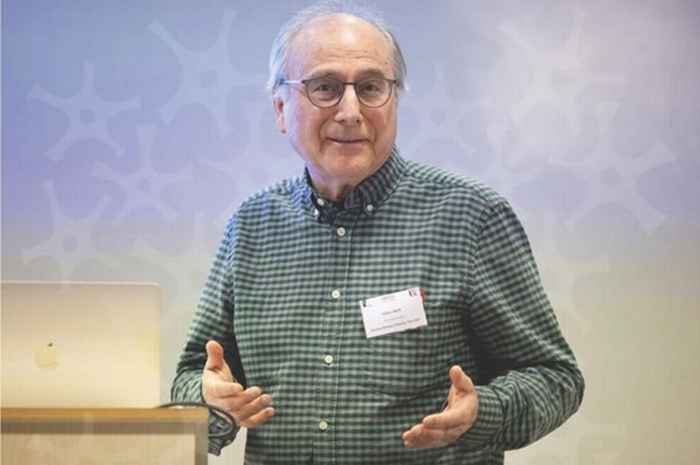
Giora Hon, Emeritus Professor for History and Philosophy of Science, University of Haifa, Israel, published widely on the theme of error in science, both from historical and philosophical points of view. Together with Bernard R. Goldstein (University of Pittsburgh) he published, as a NIAS fellow, a monograph on the concept of symmetry, From Summetria to Symmetry: The Making of a Revolutionary Scientific Concept (Springer, 2008), and subsequently a study of Maxwell’s methodological odyssey in electromagnetism, The Practice of Physics (Routledge, 2020). This work led to examining Maxwell’s role in turning the concept of model into the methodology of modeling, published in Studies in History and Philosophy of Science Part A, 88 (2021): 321–333. In an attempt to generalize the practice of physics, the two authors published the mongraph, Universal aspects of scientific practice: Commitment, methodology, and technique (SpringerBriefs in Philosophy, 2023).